We use cookies to ensure our site functions properly and to store limited information about your usage. You may give or withdraw consent at any time. To find out more, read our privacy policy and cookie policy.
Manage Cookies
A cookie is information stored on your computer by a website you visit. Cookies often store your settings for a website, such as your preferred language or location. This allows the site to present you with information customized to fit your needs. As per the GDPR law, companies need to get your explicit approval to collect your data. Some of these cookies are ‘strictly necessary’ to provide the basic functions of the website and can not be turned off, while others if present, have the option of being turned off. Learn more about our Privacy and Cookie policies. These can be managed also from our cookie policy page.
Strictly necessary cookies(always on):
Necessary for enabling core functionality. The website cannot function properly without these cookies. This cannot be turned off. e.g. Sign in, Language
Analytics cookies:
Analytical cookies help us to analyse user behaviour, mainly to see if the users are able to find and act on things that they are looking for. They allow us to recognise and count the number of visitors and to see how visitors move around our website when they are using it. Tools used: Google Analytics
Share Development Capacity Study 2026 on FacebookShare Development Capacity Study 2026 on X (formerly Twitter)Share Development Capacity Study 2026 on LinkedinEmail Development Capacity Study 2026 link
What is the Township of Esquimalt Development Capacity Study?
The Township of Esquimalt is undertaking a Development Capacity Study to better understand how much future growth our existing infrastructure and services can support. The study evaluates how different variables may impact the township's ability to realize its full development capacity.
Project background
In recent years, Esquimalt has experienced increasing development pressures. To prepare for the future, the township is assessing our capacity to accommodate new housing and development. The Development Capacity Study is a decision-support tool that will help Council, staff, and the community understand where growth can realistically occur under current policies and infrastructure constraints. It will serve as an important component of long-range planning efforts, including potential future updates to the township's Official Community Plan (OCP).
How to get involved?
Public feedback is a valuable part of this process. We want to ensure the study's findings are communicated clearly and that residents understand how different variables may impact our capacity to grow.
Review the project boards to get a quick understanding of the study and our preliminary findings.
Review the Draft Findings Report to get a deeper understanding of our methodology and preliminary findings.
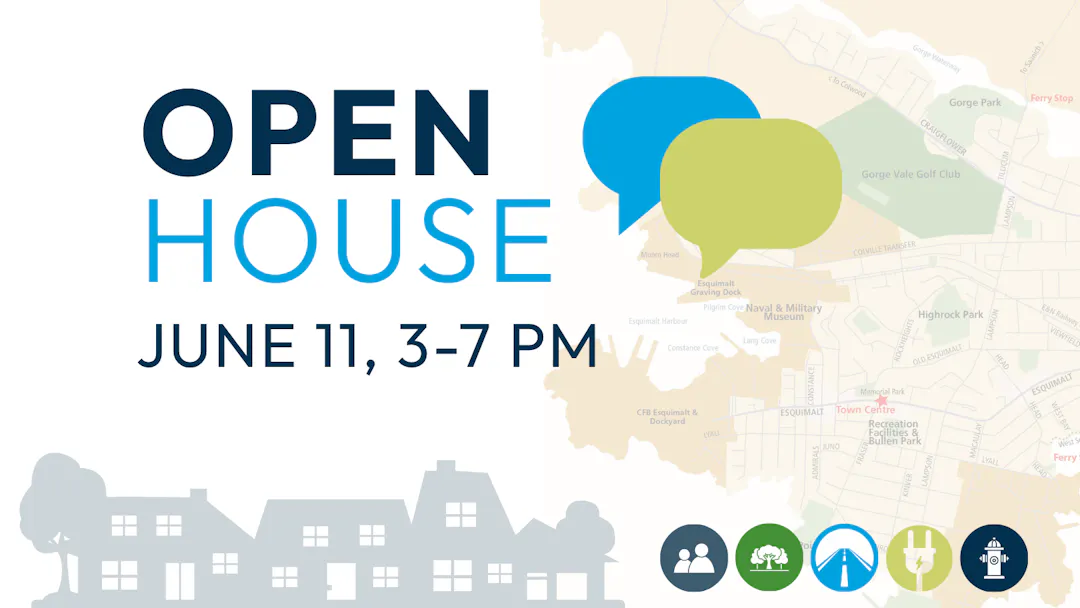
Thank you to the 70+ people who attended our open house.
While the formal feedback input has closed, you're welcome to send your thoughts to council any time at council@esquimalt.ca
Preliminary Findings
The project team has completed an initial quantitative, spatial, and qualitative analysis.
Current Units: As of 2024, there were about 10,000 housing units in Esquimalt.
Land Use Capacity: There are about 30,000 total potential housing units represented by current land use designations. That means 20,000 potential units more than today if every single parcel in the Township were to be built to the absolute maximum density.
Realizable Capacity: Most of the 20,000 potential additional units are not likely to be developed over the short-, medium- or even longer-term.
Housing Need: The OCP identifies a 20-year housing need of approximately 4,200 additional units by 2041.
Current Development: Approximately two-thirds of our projected housing need could already be addressed by recent developments and active rezoning, development, and building permits applications.
Attainable Growth: The remaining one-third of our projected housing need is attainable based on an analysis of the redevelopment potential of each parcel across Esquimalt. At the current rate of construction, it is possible to meet the projected need by 2039.
Infrastructure Support: The current utility (sewer, water, electricity) and transportation (traffic, transit) systems can accommodate the projected 20-year housing need. Considerations will need to be made to accommodate more housing on top of that, especially for sewer systems.
Emergency Services: Current Fire and Ambulance services can accommodate the projected 20-year housing need.
Green Space: There is an abundance of green space (parks, sports fields, greenways, water access points) within walking distance for most residents across the Township. Because of this, we don’t expect access to green space to represent a hard constraint to future growth in the short- or medium-term.
Recreation and Tree Canopy: Further work is needed to fully understand whether either of these variables represent constraints to future growth. Currently, we don’t expect either to represent hard constraints in the short- or medium-term.
Variables being considered
The study evaluates how a range of variables may influence the Township’s ability to realize the full development capacity envisioned through proposed land use designations, both over time and spatially across the municipality. The variables include:
Land Use: Ensuring enough lands are designated to accommodate Esquimalt's future housing needs.
Utilities: The capacity of our sanitary sewer, water, and electrical distribution systems.
Transportation: The capacity of our road network and public transit system.
Recreation, Greenspace & Tree Canopy: Access to parks and recreation facilities, as well as the protection of the urban forest.
Emergency Services: Fire and ambulance service coverage and response times.
Fiscal Considerations: Projecting municipal costs, revenues, and capital reserve funds.
What is the Township of Esquimalt Development Capacity Study?
The Township of Esquimalt is undertaking a Development Capacity Study to better understand how much future growth our existing infrastructure and services can support. The study evaluates how different variables may impact the township's ability to realize its full development capacity.
Project background
In recent years, Esquimalt has experienced increasing development pressures. To prepare for the future, the township is assessing our capacity to accommodate new housing and development. The Development Capacity Study is a decision-support tool that will help Council, staff, and the community understand where growth can realistically occur under current policies and infrastructure constraints. It will serve as an important component of long-range planning efforts, including potential future updates to the township's Official Community Plan (OCP).
How to get involved?
Public feedback is a valuable part of this process. We want to ensure the study's findings are communicated clearly and that residents understand how different variables may impact our capacity to grow.
Review the project boards to get a quick understanding of the study and our preliminary findings.
Review the Draft Findings Report to get a deeper understanding of our methodology and preliminary findings.
Thank you to the 70+ people who attended our open house.
While the formal feedback input has closed, you're welcome to send your thoughts to council any time at council@esquimalt.ca
Preliminary Findings
The project team has completed an initial quantitative, spatial, and qualitative analysis.
Current Units: As of 2024, there were about 10,000 housing units in Esquimalt.
Land Use Capacity: There are about 30,000 total potential housing units represented by current land use designations. That means 20,000 potential units more than today if every single parcel in the Township were to be built to the absolute maximum density.
Realizable Capacity: Most of the 20,000 potential additional units are not likely to be developed over the short-, medium- or even longer-term.
Housing Need: The OCP identifies a 20-year housing need of approximately 4,200 additional units by 2041.
Current Development: Approximately two-thirds of our projected housing need could already be addressed by recent developments and active rezoning, development, and building permits applications.
Attainable Growth: The remaining one-third of our projected housing need is attainable based on an analysis of the redevelopment potential of each parcel across Esquimalt. At the current rate of construction, it is possible to meet the projected need by 2039.
Infrastructure Support: The current utility (sewer, water, electricity) and transportation (traffic, transit) systems can accommodate the projected 20-year housing need. Considerations will need to be made to accommodate more housing on top of that, especially for sewer systems.
Emergency Services: Current Fire and Ambulance services can accommodate the projected 20-year housing need.
Green Space: There is an abundance of green space (parks, sports fields, greenways, water access points) within walking distance for most residents across the Township. Because of this, we don’t expect access to green space to represent a hard constraint to future growth in the short- or medium-term.
Recreation and Tree Canopy: Further work is needed to fully understand whether either of these variables represent constraints to future growth. Currently, we don’t expect either to represent hard constraints in the short- or medium-term.
Variables being considered
The study evaluates how a range of variables may influence the Township’s ability to realize the full development capacity envisioned through proposed land use designations, both over time and spatially across the municipality. The variables include:
Land Use: Ensuring enough lands are designated to accommodate Esquimalt's future housing needs.
Utilities: The capacity of our sanitary sewer, water, and electrical distribution systems.
Transportation: The capacity of our road network and public transit system.
Recreation, Greenspace & Tree Canopy: Access to parks and recreation facilities, as well as the protection of the urban forest.
Emergency Services: Fire and ambulance service coverage and response times.
Fiscal Considerations: Projecting municipal costs, revenues, and capital reserve funds.
Share We'd like to hear from you on FacebookShare We'd like to hear from you on X (formerly Twitter)Share We'd like to hear from you on LinkedinEmail We'd like to hear from you link